At the Bamford Lab we study how humans and animals sense, fight and control viral infection, from the interferons of the innate immune response to the RNA viruses that jump between species and spark new epidemics. Taking a One Health perspective, and drawing on all we learned through the COVID-19 pandemic, we track emerging and zoonotic threats and unite virology, evolution and drug design with deep learning and AI to turn that understanding into new ways to stop disease.

Antiviral immunity is our central question: how cells and animals sense viral infection, switch on the interferon response, and keep that defence in balance, especially at the mucosal surfaces where infection begins and against the RNA viruses that jump between species. What makes the lab distinctive is that we pursue it from four directions at once.
Hands-on molecular virology of the RNA viruses that jump between species: how they infect cells, replicate, and trigger or evade the immune response.
Read more →Reading the evolutionary arms race between hosts and viruses to understand where immunity came from and where it is going.
Read more →Deep learning and large-scale biological data to decode how cells communicate during infection, and to model immunity faster than experiments alone allow.
Read more →Turning discoveries about immune defence into new antivirals and strategies to strengthen the body's own response to infection.
Read more →
Virologists and immunologists working alongside evolutionary and computational biologists, led by Dr Connor Bamford and united on one question: antiviral immunity.
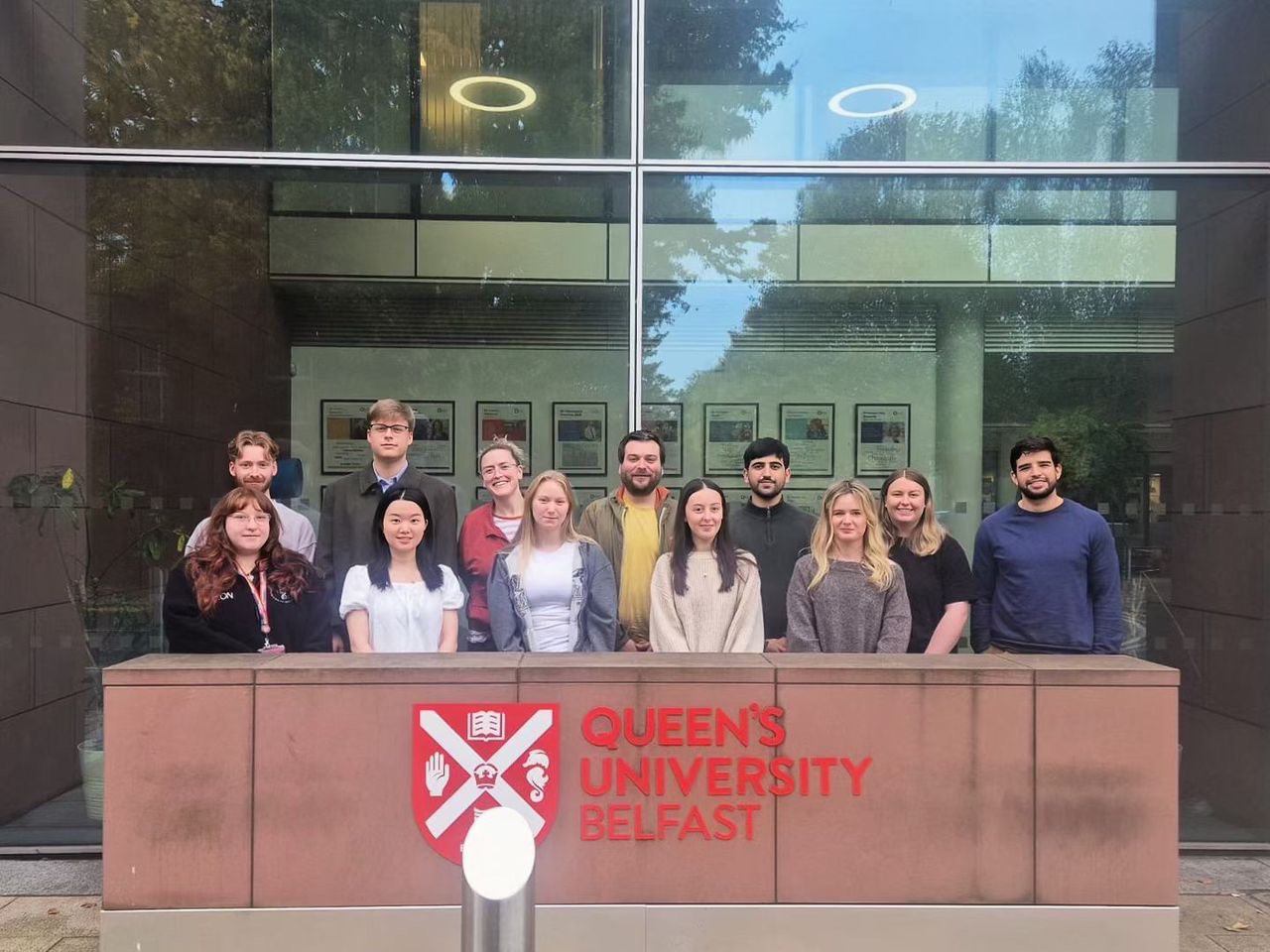
Eighteen of us, from undergraduate project students through to postdoctoral researchers, sharing a bench, a corridor and a lot of coffee. We care as much about training good scientists as we do about the discoveries themselves.
Meet the labGrants, papers, conferences, new starters and lab life. The three latest show here; the full history lives on the news page.
Our new home on the web goes live. Welcome to the prospective students joining us this autumn.
James gave a talk, "Integrating evolutionary biology and deep learning to uncover selective druggable targets in virally targeted immune signalling", and Mollie, Jiaying and Banbha presented posters on viruses of nematodes, pollution and pathogens in wild otters, and tick-borne flaviviruses in Northern Ireland. Photos on the people page.
Emer joins us as a Research Fellow on EnviroFlu, surveilling avian influenza in freshwater sites used by wild migratory waterbirds across the island of Ireland. Meet Emer.
We are based in the School of Biological Sciences at Queen's University Belfast, one of the UK and Ireland's leading research universities, in the heart of a friendly, affordable and creative city.
Good science needs different minds, and we welcome people of every background, nationality, ethnicity, gender identity, sexual orientation, religion, age and disability status. Positions are advertised openly, everyone gets proper mentoring, and we work with people who have caring responsibilities or health conditions to find arrangements that fit.
If you are not sure whether you would fit, please get in touch.
The Bamford Lab sits within the School of Biological Sciences at Queen's University Belfast, which holds an Athena Swan Gold award in recognition of its work on gender equality, and was the first School of Biology in the UK to reach that level.
We welcome curious, motivated people at every stage. If our questions excite you, get in touch, even just to chat about possibilities.
Opportunities come up at every stage, from undergraduate projects through PhDs to postdoctoral posts. We are always glad to hear from people who have their own funding, or who are looking for help to apply for it. Tell us a little about yourself and what you would like to work on, and we will point you to the routes and the next steps.
Email to enquire